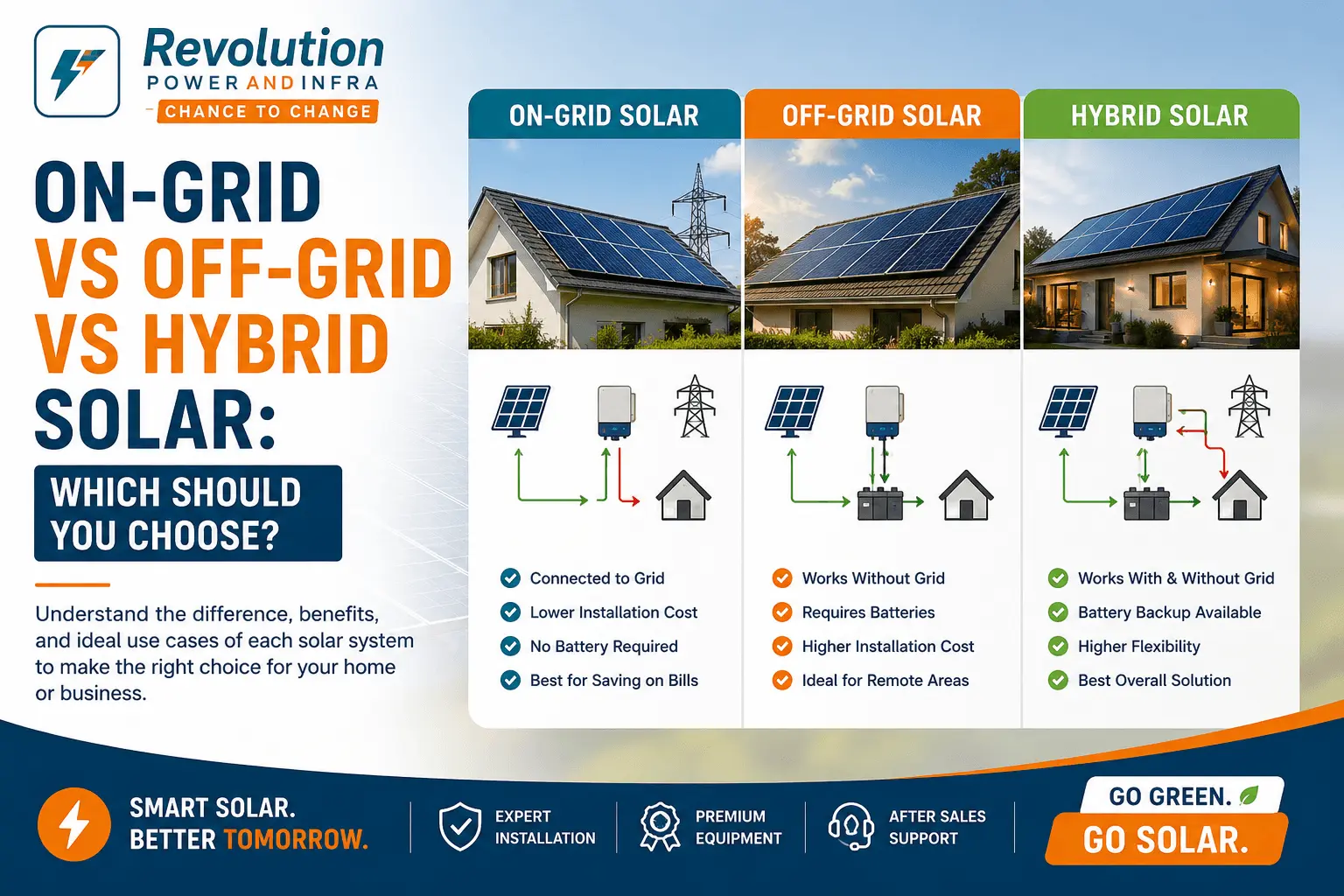
Quick summary: On grid solar is pretty cheap and also “best” for houses where the electricity supply is steady. Off grid, on the other hand, is better suited for places that have no grid at all or where power cuts happen very often. Hybrid setup gives you a nice blend, meaning grid connection with a battery backup included, and it is also the quickest growing option right now for urban homes in Rajasthan in 2026.
Most people decide to go solar and then kinda get stuck on one question, on-grid off-grid or hybrid?
It sounds technical, but the actual decision is simpler than it looks. Each system suits a different situation. Choose the wrong one and you either overpay for features you do not need, or underinvest and end up with a system that does not cover you when the power goes out.
Rajasthan gets some of the best sunlight in India, 5.5 to 6 units per square metre every day. So whichever system you go for here, it’s going to work well. The only part is figuring out what matches your home your budget, and how often your locality faces power cuts.
An on-grid setup is usually the easiest entry into solar, and it tends to be the most budget friendly option. For many homes around Jaipur, it’s also the most reasonable place to begin. Let’s break down how it works, and what it usually involves.
Your solar panels spend the day doing one job, generating electricity. That power goes straight to your home first, running whatever is switched on. If the panels are producing more than you are using at that moment, the extra units flow out to the grid and your DISCOM credits you for them at a rate set by RERC through net metering. Come evening, or on a grey day when the panels are barely producing, you just pull from the grid the way you always have. Simple as that.
No batteries required, that is what keeps the cost down.
Off-grid solar is basically for situations where the utility grid either does not exist or can’t be fully trusted. It is the most independent setup, but also the most expensive. Here is what it involves.
There is no grid connection here at all. Your panels spend the day charging a bank of batteries, and those batteries are basically what keeps your home powered, even when its midday, or midnight, sunny, or overcast, it kind of doesn’t matter. You are not pulling from any utility supply. What your panels collect is what you live on, and a properly sized system makes sure there is always enough stored to see you through the night and a cloudy day or two.
Hybrid solar is the fastest growing pick among Indian homeowners in 2026, and for pretty good reason. It sort of blends the savings of on grid setup with that extra peace of mind from off grid backup. Here’s what makes it feel different.
A hybrid solar setup links with both the electricity grid and a battery bank. In daytime, solar power keeps your home running and it also recharges the batteries at the same time. If the grid is there, and the batteries are already full, any extra power can be pushed back through net metering. When the grid suddenly goes off, the battery bank feeds your home backup power automatically. At night, you typically pull energy from the batteries first, and only then use the grid if you still need more.
Now that you basically know how each system works, here’s how they really compare with each other, on price, backup, upkeep and what scenario each one is meant for.
| System Type | Approximate Cost After Subsidy | Payback Period |
| On-Grid | ₹2.7 – ₹3 lakh | 3 – 4 years |
| Off-Grid | ₹4.5 – ₹6 lakh | 6 – 7 years |
| Hybrid | ₹5 – ₹7 lakh | 5 – 7 years |
| System Type | Works During Power Cut? | Night Power Source |
| On-Grid | No | Grid |
| Off-Grid | Yes | Battery |
| Hybrid | Yes | Battery, then Grid |
Rajasthan sees some of the highest solar irradiation across India, so in general any solar arrangement here tends to work quite well. Still the real question is which option suits your location and day to day routine best, and honestly the answer shifts depending on where you live.
In Jaipur’s urban pockets, like Vaishali Nagar, Mansarovar, C-Scheme, Jagatpura, the grid supply is fairly dependable. For most urban homeowners, hybrid solar is the practical right choice in 2026. Power cuts happen sometimes, especially in summer when demand is high, and the heat is doing its thing. With a hybrid system, your solar investment stays useful even if the grid slips, and that additional ₹60,000 to ₹1 lakh over on-grid buys you real energy security for about 25 years.
For properties in rural Rajasthan or areas where grid supply is genuinely unreliable or absent, Sikar district villages, remote Shekhawati areas, off-grid solar is the correct choice. Energy independence makes more sense where the grid cannot be relied upon at all.
If you’ve got businesses in Jaipur with steady, daytime electricity use, like showrooms, offices, and factories, then on-grid or hybrid commercial solar usually makes the most sense. On-grid tends to be the lowest payback option but hybrid gives you extra backup protection, so operations don’t just stop when outages happen.
Before you finalize anything, run through these four things first. It will narrow your choice fast, and helps avoid picking the wrong setup for your exact situation.
If upfront cost is the primary constraint, on-grid is the starting point. If you can budget for the higher initial investment, hybrid pays back better over the system’s life in most Jaipur scenarios.
Pull your last three electricity bills and check your average monthly units. This determines the system size you need, and whether a battery-backed system makes economic sense for your usage pattern.
How many hours of power cuts do you experience per day, on average? Less than 1 to 2 hours, on-grid is fine. More than 2 to 3 hours regularly, hybrid is worth the extra investment.
A 5kW system needs approximately 350 to 500 square feet of shadow-free roof space. A 10kW system needs 700 to 1,000 square feet. Assess your available space before deciding on system size.
For most homeowners in Jaipur and urban Rajasthan in 2026, hybrid solar is the right answer.
Grid tariffs are rising every year. Power cuts are an occasional reality in summer. A hybrid system gives you maximum bill savings through net metering, power security through battery backup, and a payback period of 5 to 6 years, after which 19 to 20 years of near-free electricity follow.
On-grid makes sense if your budget is tight and power cuts in your area are genuinely rare. Off-grid only makes sense if you have no reliable grid access at all.
The right solar system is the one that fit your electricity needs, your budget, and the grid reliability where you are located, not only the cheapest option or the most technically advanced one.
Revolution Power & Infra helps homeowners across Jaipur and Rajasthan sort out this decision, with a pretty candid take on what will really work best for your home. If you are unsure which system is right for you, a site visit and consumption analysis makes the answer clear before any money is committed.
Get in touch with the Revolution Power team for a free consultation and roof assessment.